It’s 11 p.m. Your ear is throbbing. You rummage through the bathroom cabinet — no ear drops. The pharmacy’s closed. And the pain isn’t letting up.
Sound familiar?
Here’s the thing: a mild earache doesn’t always need drops. Sometimes the simplest fixes are already in your kitchen, your linen closet, or just your own two hands. And they can take the edge off fast.
So let’s walk through exactly how to soothe a mild earache without drops. No gimmicks. No weird internet hacks. Just practical moves that actually help.
Why Your Ear Hurts (A Quick Reality Check)

Before you start treating anything, it helps to know what you’re dealing with.
Most mild earaches come from a few common culprits: pressure changes (flights, altitude shifts), a bit of trapped water after swimming, mild congestion from a cold, or slight inflammation in the ear canal. Sometimes it’s just a blocked Eustachian tube — the tiny passage connecting your middle ear to your throat.
The pain feels sharp, dull, or like a constant low-grade pressure. Maybe it’s worse when you chew or lie down.
That said, if the pain is severe, accompanied by fever above 38.5°C / 101.3°F, discharge, or hearing loss that came on suddenly, that’s not “mild.” Skip the home remedies and call a doctor.
For everything else? Read on.
Fix #1: The Warm Compress (Your First Move)
This is the single most effective no-drop remedy. And it’s stupidly simple.
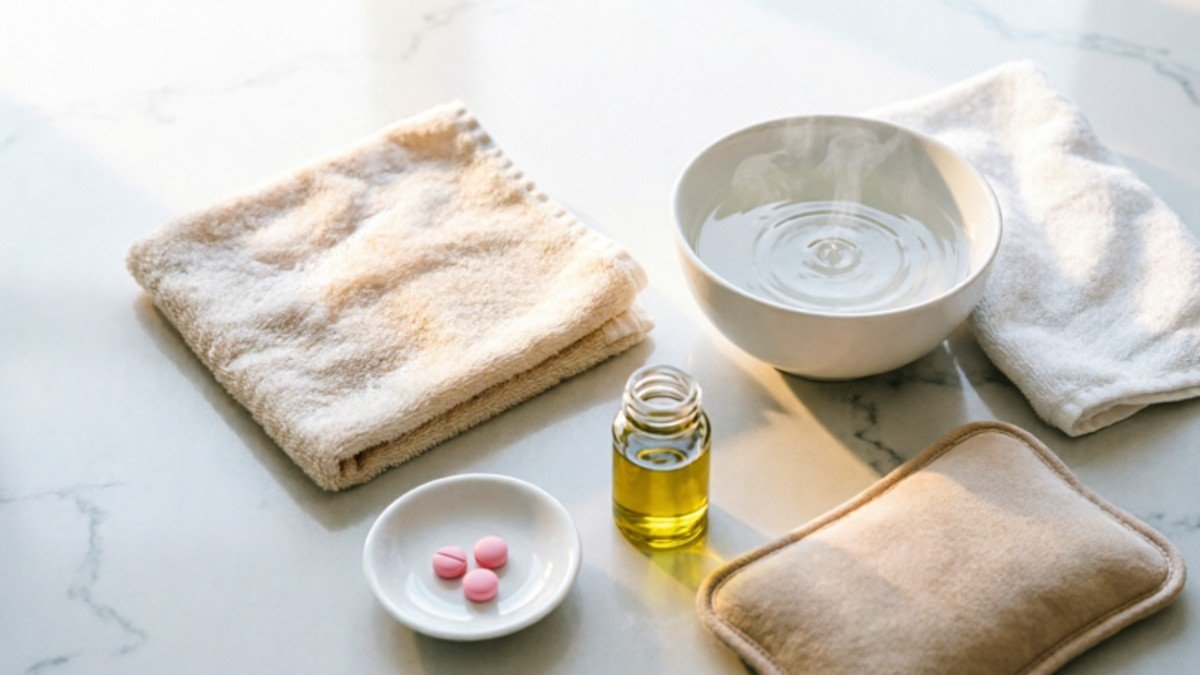
Soak a clean washcloth in warm water — not hot, warm. Wring it out. Hold it against the affected ear for 15 to 20 minutes. The warmth increases blood flow to the area, relaxes tense muscles around the ear canal, and can ease that throbbing pressure.
A warm compress is the first thing I tell patients to try. It’s gentle, it’s safe, and for mild congestion-related ear pain, it genuinely helps reduce discomfort within minutes.” — Dr. Sarah Whitmore, ENT Specialist, 14 years in clinical practice
You can repeat this every few hours. Some people prefer a heating pad on low, wrapped in a thin towel. Same idea. Just don’t fall asleep with it pressed against your ear.
| Compress Type | How To | Duration | Best For |
|---|---|---|---|
| Warm washcloth | Soak, wring, hold against ear | 15–20 min | General mild ache |
| Heating pad (low) | Wrap in towel, place near ear | 15 min max | Deeper pressure pain |
| Warm salt sock | Heat salt in sock, microwave 30 sec | 10–15 min | Congestion-related pain |
| Cool compress | Cold damp cloth | 10 min | Swelling or sharp pain |
Fix #2: Gentle Massage Around the Ear
Not inside the ear. Around it. Big difference.
Use your fingertips to press gently in small circles just behind your ear, along the jawline, and at the base of your skull where the neck meets the head. You’re targeting the muscles and lymph nodes that surround the ear canal.
Here’s a simple sequence:
- Press the soft spot just behind your earlobe. Hold for 10 seconds.
- Trace small circles along your jaw, from ear to chin.
- Press the indentation at the base of your skull. Hold for 15 seconds.
- Gently pull the earlobe down and back. Hold. Release.
Do this for 2 to 3 minutes. You might feel a little relief from pressure buildup, especially if congestion is the cause.
And that’s it. No fancy tools needed.
Fix #3: Steam Inhalation
If your earache is tied to a stuffy nose or sinus pressure, steam is your friend.
Boil water. Pour it into a bowl. Lean over it with a towel draped over your head. Breathe slowly through your nose for 5 to 10 minutes. The steam helps open the Eustachian tube and lets trapped pressure equalize.
You can do this two or three times a day. A hot shower works too, if you’d rather not fuss with bowls.
Just be careful not to burn your face. Keep a comfortable distance.
Fix #4: Elevate Your Head
Lying flat makes ear pain worse. Gravity causes fluid to pool in the middle ear, increasing pressure.
So prop yourself up. Use two pillows. Sleep slightly reclined. Even sitting upright in a chair for 30 minutes can reduce that throbbing sensation.
This one’s especially helpful at night when the ache seems to spike.
Fix #5: Over-the-Counter Pain Relief (Not Drops)
No drops doesn’t mean no medication.
Ibuprofen (200–400 mg) or acetaminophen / paracetamol (500–1000 mg) can reduce inflammation and dull the pain. Follow the dosing instructions on the package. Don’t exceed the daily limit.
| Medication | Typical Adult Dose | What It Does | Caution |
|---|---|---|---|
| Ibuprofen | 200–400 mg every 6–8 hrs | Reduces inflammation + pain | Avoid on empty stomach |
| Acetaminophen / Paracetamol | 500–1000 mg every 6 hrs | Reduces pain + fever | Don’t exceed 3,000–4,000 mg/day |
| Naproxen | 220 mg every 12 hrs | Longer-lasting anti-inflammatory | Not for stomach ulcer history |
People forget that oral painkillers are often more effective than topical drops for mild ear pain. Drops treat the surface. Ibuprofen treats the inflammation underneath.” — Dr. Marcus Chen, General Practitioner, Family Medicine
This isn’t a long-term fix. But for getting through the night? It works.
Fix #6: The Valsalva Maneuver (Gently!)
You know that “pop” you feel on an airplane? You can recreate it to relieve pressure.
Pinch your nose shut. Close your mouth. Blow out gently — very gently — as if you’re trying to blow your nose. You might feel a small pop in your ear. That’s the Eustachian tube opening.
Do not force it. Do not blow hard. If it doesn’t pop after two gentle tries, stop.
This works best for pressure-related aches — flights, altitude changes, mild congestion. If your ear is infected, skip this one.
Fix #7: Olive Oil or Garlic Oil (Warm, a Few Drops)
Okay, I know you said “without drops.” But hear me out.
This isn’t a medicated ear drop from the pharmacy. This is a teaspoon of slightly warmed olive oil — or olive oil infused with garlic — placed gently at the ear opening. Not shoved deep. Just a few drops at the entrance to soothe irritation.
Warm the oil to body temperature. Test it on your wrist first. Lie on your side. Let 2 to 3 drops sit at the opening of the ear canal. Stay there for 5 minutes.
Some people find this comforting. Research is limited, but general medical consensus suggests it’s unlikely to cause harm for an intact eardrum.
That said — if you suspect a perforated eardrum, do NOT put anything in your ear. Not oil, not water, nothing. See a doctor.
What NOT to Do (Seriously, Skip These)
This part matters as much as the remedies.
| Bad Move | Why It’s a Problem | Do This Instead |
|---|---|---|
| Sticking cotton swabs inside the ear | Pushes wax deeper, can scratch the canal | Leave the ear canal alone |
| Using hydrogen peroxide without guidance | Can irritate already-sensitive tissue | Stick to warm compresses |
| Blowing your nose hard to “pop” the ear | Forces mucus into the middle ear | Use gentle Valsalva or steam |
| Ignoring pain for more than 48 hours | Mild can become serious fast | See a doctor if it lingers |
| Putting hot objects directly on the ear | Risk of burns | Always use a cloth barrier |
| Using random essential oils undiluted | Can cause chemical burns in the canal | Avoid or heavily dilute with carrier oil |
The number one mistake I see? People stick things in their ear trying to ‘fix’ it. Cotton buds, hairpins, rolled-up tissues. Your ear canal is delicate. Leave it alone and let it heal.” — Dr. Anika Patel, Audiologist, Hearing & Ear Health Clinic
When It’s Not “Mild” Anymore
A mild earache should start easing within 24 to 48 hours with home care. If it doesn’t, or if any of these show up, stop self-treating and see a healthcare provider:
- Pain that gets worse after 2 days
- Fever above 38.5°C / 101.3°F
- Fluid, pus, or blood draining from the ear
- Sudden hearing loss or ringing
- Swelling behind the ear
- Dizziness or balance issues
- Ear pain in a child under 2 years old
None of these are “wait and see” situations.
Quick Reference: Your No-Drop Earache Toolkit
| Method | Time Needed | Best For | Safety Level |
|---|---|---|---|
| Warm compress | 15–20 min | General ache, pressure | Very safe |
| Massage (around ear) | 2–3 min | Tension, mild congestion | Very safe |
| Steam inhalation | 5–10 min | Sinus/cold-related pain | Safe (watch for burns) |
| Head elevation | Ongoing | Night pain, fluid pressure | Very safe |
| OTC painkiller | Immediate | Inflammation, moderate pain | Safe (follow dosing) |
| Gentle Valsalva | 10 sec | Pressure from flights/colds | Safe if done gently |
| Warm olive oil (2–3 drops) | 5 min | Dry, irritated canal | Safe IF eardrum intact |
Key Takeaways
✓ How to soothe a mild earache without drops usually starts with a warm compress and gentle massage — simple, free, effective.
✓ Steam and head elevation work surprisingly well when congestion is the culprit.
✓ Oral painkillers like ibuprofen often outperform topical drops for mild inflammation.
✓ Never stick objects into your ear canal. Not swabs, not pins, not your finger.
✓ A mild earache should ease within 48 hours. If it doesn’t, see a doctor.
✓ Warm olive oil at the ear opening can soothe, but skip it if you suspect any eardrum damage.
✓ When in doubt, call a professional. Ears are not the place for experimentation.
FAQ
Q: How to soothe a mild earache without drops — does it actually work? A: For mild, pressure-related, or congestion-related ear pain, yes. Warm compresses, steam, and gentle massage can reduce discomfort noticeably within 15 to 30 minutes. They won’t cure an infection, but they ease the pain while your body handles the rest.
Q: How long does a mild earache usually last? A: Most mild earaches improve within 24 to 48 hours. If yours lasts longer than two days or gets worse, that’s a signal to see a doctor rather than keep trying home fixes.
Q: Can I use a warm compress on a child’s ear? A: Yes. Use a warm (not hot) washcloth. Hold it gently against the ear for 10 minutes. Check the temperature on your wrist first. Kids’ skin is more sensitive, so keep it comfortably warm, never hot.
Q: Is it safe to put olive oil in my ear? A: Only if your eardrum is fully intact. Two to three drops of body-temperature olive oil at the ear opening is generally considered safe. If you have any history of eardrum perforation, ear tubes, or discharge, skip it entirely.
Q: What’s the fastest way to relieve ear pressure? A: The Valsalva maneuver (pinch nose, blow gently) combined with steam inhalation tends to work fastest for pressure. A warm compress right after adds relief. Total time: about 10 to 15 minutes.
Q: Can sleeping position affect earache pain? A: Yes. Lying flat increases fluid pressure in the middle ear. Propping your head up with an extra pillow or sleeping slightly upright can reduce throbbing significantly.
Q: Should I take ibuprofen or acetaminophen for an earache? A: Ibuprofen has the edge because it reduces inflammation, not just pain. But if you can’t take NSAIDs (stomach issues, blood thinners), acetaminophen works well for pain and fever. Follow package dosing.
Q: Can allergies cause an earache? A: They can. Allergies cause congestion and fluid buildup in the Eustachian tube, which creates pressure and pain. An antihistamine plus steam may help. If it keeps recurring, talk to a doctor about managing the allergy.
Q: Is it okay to use a hairdryer to warm my ear? A: Some people do this on the lowest heat setting, held at least 30 cm / 12 inches away. But honestly, a warm washcloth is safer, more controlled, and just as effective. Skip the hairdryer.
Q: Can chewing gum help an earache? A: It can help with pressure equalization, especially during flights or altitude changes. The jaw movement encourages the Eustachian tube to open. It won’t fix an infection, but it can ease mild pressure discomfort.
Q: When should I absolutely see a doctor for an earache? A: If you have fever above 38.5°C, discharge from the ear, sudden hearing loss, pain lasting more than 48 hours, swelling behind the ear, or dizziness. Also, any earache in a child under 2 warrants a same-day medical visit.
Q: Can water trapped in the ear cause an earache? A: Yes. Swimmer’s ear (otitis externa) starts with trapped moisture irritating the ear canal. Tilting your head, gentle gravity drainage, and a warm compress can help. If it doesn’t clear in a day or two, see a doctor before it turns into an infection.
Q: Are ear candles safe for earaches? A: No. Skip them entirely. Medical consensus is clear: ear candles don’t remove wax, don’t relieve pressure, and carry a real risk of burns and ear canal injury. They’re not a remedy. They’re a hazard.
Q: Can stress or jaw tension cause ear pain? A: Surprisingly, yes. TMJ (jaw joint) tension and teeth grinding can refer pain to the ear. If your earache comes with jaw stiffness or you clench your teeth at night, gentle jaw stretches and a warm compress on the jaw may help more than anything you’d put in the ear.